Showing posts with label Written By Sasha Midgley. Show all posts

Wednesday, 17 April 2013

5. Evaluation Question: How Did You Attract/Address Your Audience

How Did You Attract/Address Your Audience?


We wanted to create a creature feature opening (see here research into what genres)
We chose this because it's a not a well known sub genre of horror and we felt it would appeal to our target audience of the 15-25 year olds.


We used a teenage boy, similar age of our target audience making it easier for them to relate and sympathise with the character. (Click here for the potential actors for the part)
When originally planning the opening we wanted to use a cast of young teenagers that found their way to the house to really appeal to our audience, we've seen this used in films such as 'House of Wax' and thought this would be perfect for our target audience but using one actor resulted in being more convenient and vulnerable.

We predicted our secondary audience would be aimed at an older audience, 45+, after looking at the results for the ages of the audience attending the well known horror films 'The Number 23' and 'Secret Window' both showing that people over 45 went to see the film.


Due to our low budget we used a lot of social network sites and other free promotional sites available to us such as Youtube and facebook to get our media product known. We posted the final media product onto Youtube (Which can be watched by clicking here) allowing anyone to see the footage and give feedback using the 'like/dislike' feature on Youtube. By uploading the media product onto a video sharing website, it has the potential to go viral becoming available to thousands of people globally.


Social media sites such as youtube, twitter and facebook are popular amongst our target audience giving us access to make users of these sites aware of our media product for free.
 
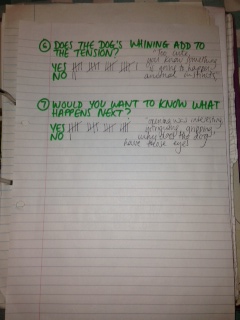
Including a dog in the opening helped provoke a lot of sympathy from the audience, as dogs are seen as man's best friend and they wouldn't want to see the animal harmed.
In all feedback we received  the whimpering of the dog was featured frequently showing just how much attention the dog gained in the opening.


The horror film genre is very popular amongst young adults, and the opening is left on a cliff hanger helping, enhancing the suspense for our audience.
Desolate challenges contemporary conventions of the genre as we went against the stereo type of a typical horror film, in that we used a male protagonist and an animal.

Tuesday, 16 April 2013

4 Evaluation Question: Who Would be the Audience for Your Media Product?

Who Would be the Audience for Your Media Product?

After research, we found that the genre we wanted to create (creature feature) appealed most to 15-25 year olds, this is because of various aspects of the opening.
We chose a male actor to appeal to the female audience as they would sympathise with him and his dog, it also challenged regular conventions of a horror film, with a female victim as women are seen as more vulnerable.

 We were influenced to release the media product around the October holidays as this the Halloween season and our target audience would be more available to visit the cinema.
The media product is not biased to males or females, both genders could go and see the film.


We chose to use a average, teenage boy that the audience could relate to. It's a realistic situation, which could be possible for anyone to be in.


We decided on the certificate to be a 15, it appeals more to the audience
15 is an age where the cinema is seen as a social event, teenagers 15/16 aren't old enough to go out at night and drink and also can't drive

2 Evaluation Questions How Does Your Media Product Represent Particular Social Groups

How Does Your Media Product Represent Particular Social Groups?

Our media product featured a number of social groups, an example of this is evident in the first shot, showing a middle class teenager taking his dog for a walk. We thought this would relate to our target market of teenagers. The abandoned house used in the opening scene resembles a squat, it's deserted, abandoned and dirty, these features can be associated with lower class.
The teenage boy is not seen as a stereotypical dog walker, usually mother or father take the responsibility, his loyalty is later shown when trying to find the missing dog, sympathy can be felt for both the dog and owner as both are in a vulnerable situation, contrasting with the being of the opening.

We purposely filmed the opening, excluding the houses surrounding the location, to make the house look even more desolate than in reality.


Kieran's costume
The house appears to be vandalised, which helps set the scene for our target audience of young adults. It also make the house look like it's been inhabited before, and the risk of something/someone still being inside.


The dog helps to make audience members fond of animals feel engage more in the opening and feel sympathy.


Friday, 22 March 2013

Feedback From the Opening


 We presented our film opening in front of the target audience and then created a questionnaire for everyone to fill out, this was so that we could get feedback on various areas and amend these or justify them.
These are the headings of the questions and the tally charts that we created with all the filled out questionnaires and also quoting some of the most useful answers.


Examples of the questionnaire we gave for the audience to answer.

Thursday, 21 March 2013

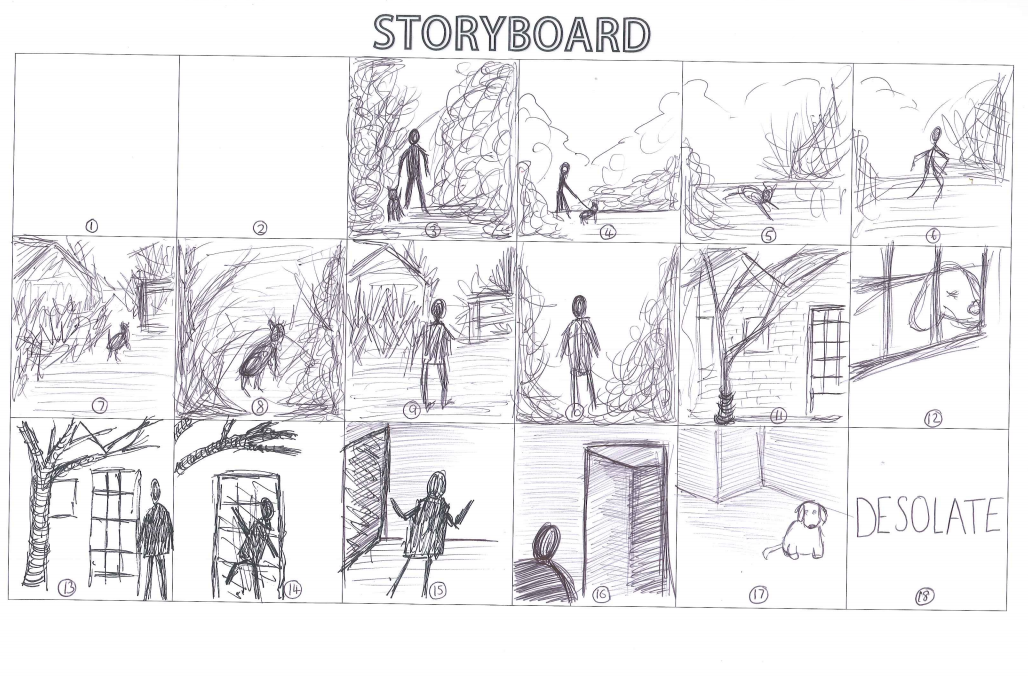
The Final Narrative and Storyboard

The Final Narrative and Storyboard

The final narrative included Kieran walking the dog, we thought it was more realistic and made Kieran look more vulnerable to be alone.
The teenage boy, is walking his dog, on a cold winters day. He chooses to be spontaneous and goes on a completely new walk. His dog seems to sense something and runs off. Kieran runs after him, and stumbles onto a deserted house, only to find that the house and dog is possessed.
We chose to use minimal dialogue to not over power the music and kept to create the suspense.


Saturday, 2 March 2013

Blog Responses

We presented the first few posts on the blog to our class and this was some of the feedback they gave:


I think we have successfully amended and added their constructive criticism given to the blog. And now the blog contains what was asked and more.
We chose a black background because black suited with the horror genre.  

Adapting the Narrative


Narrative:

We adapted our narrative to include a dog walk as we thought this was a more realistic way to come across the haunted house.
The scene starts with Kieran walking his dog, which then proceeds to run into the deserted house…  Keiran follows and finds himself outside the house, conscious of entering, the dog doesn’t appear so Kieran is forced into the house where he find his dog…

Coincidentally there was graffiti already at the house which involved a dog, seen below.
We thought this fitted our media product perfectly as we wanted the audience to get the feeling that someone/something is in the house watching the dog walker.
The graffiti helped foreshadowed that something was going to happen to the dog.

Friday, 1 March 2013

Graffiti Found in the Abandoned House

This is a poster advertising the film 'Sinister.'
I thought the face on the wall was really effective
which is why we included the footage of a similar threatening
graffiti face found on a wall in the abandoned house


We also discovered some graffiti in the house which included
a dog and the writing refering to animals which coincidentally fitted our narrative well so we included it in our openning. It helps foreshadow that something will
happen involving the dog in the openning. 


Wednesday, 30 January 2013

Narrative


Narrative Theory

How do they introduce the characters/setting?
  • The setting is introduced as very scary and sinister. We created this by enhancing the shadows and making the unknown more present. In addition, the location itself is chilling which helped us.
  • The characters we've created were inspired by our target audience, we wanted a group of teenagers so the audience could relate to the narrative.
Does it foreshadow conflict?
  • We have created short shots which give the impression someone planned what will happen to the characters. The photographs show that the mysterious
How is binary opposition  presented?
  • In our opening we are representing the male actor as 'good'; we have done this by making him seem protective over his dog. On the other hand we have represented the house as 'bad' by making it seem like it has this possessed quality. The look of it helps to convey this perfectly.


Cast

 
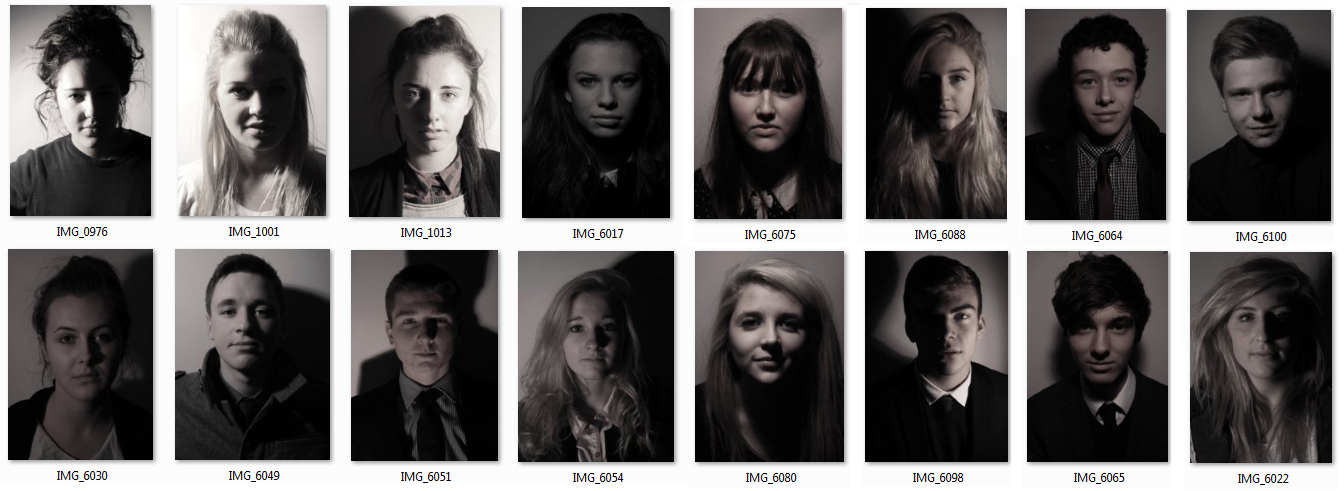
Potential People to Feature in the Film Opening
 

In our film opening, we visioned a group of teenagers, girls and boys going into the house.
We thought this group would appeal most to our target audience of young adolescents.
Here are a few of the photographs taken (in the style of headshot) of the potential actors used in our opening.

Tuesday, 15 January 2013

Original Ideas for Narrative


When originally discussing what we wanted the narrative to be, we wanted to give the impression
that someone was in the house and had planned for people to enter the abandoned house and we also wanted to use a cast of teenagers to suit our target audience.

We created a variety of ways to try and make it appear that someone/something was in the house watching the group of people...

One of the ways we planned to do this was by having a shot of some photographs of the teenagers unaware that the photographs was being taken.
I would've used a polaroid camera and taken 'stalker' style photographs (Image 3)
and had the photographs falling in slow motion for the opening scene (Image 1), or zoomed out for a lot of photographs scattered on the floor. (Image 2)

These photographs were found on the internet, but represent what I would've wanted to include in our media product:

Image 1


Image 2


Image 3

Another way we would've created the impression someone was watching the group was through of giving the impression someone was waiting impatientally, to achieve this we planend to include some finger nails tapping, edited with  through rapid cuts to help create suspense throughout the opening of the scene.


We also thought the best shot to create tension in the opening scene would be using a panning shot of the house.


Devil's Footsteps

I discovered the poem in the book below and thought it would be perfect to voice over the scene of Kieran walking up to the abandoned house. But unfortunately the poem is copyrighted so could not used in our openning. 
The book 'Devil's Footsteps' where the poem is featured


Wednesday, 9 January 2013

Sub Genres Within Horror

Sub Genres Within Horror
After looking at a number of sub genres in Horror, we decided to chose to create a Creature Feature Film, with elements of the super natural sub genre.

Wednesday, 19 December 2012

Women in Black Analysis

 The Women In Black


The Location:
The abandoned house is very dull and intimidating looking with over grown grass all around.This shows there is no human evidence around.
Big black iron gates outside may show that the house is ancient and sinister.


                                                           Camera Work:
The use of this point of view shot is very effective and really


Monday, 17 December 2012

Research Into Horror Films

Looking and Analysing Previous AS Media Tasks:


Camera Shots:
  • The running scene is very effective as the camera work is very realistic.
  • Use of hand held camera work (tracking) is very good throughout the scene.
  • Close up shots
  • Establishing shots
  • Long shots
  • Mid shots
  • Point of View shots
  • High angle shots
  •  
 Location:
  • The graveyard
  • The wooded area
  • The barn
 
Mise-en-scène:
  • The girls is wearing just a beige coat, jeans and ugg boots.
  • There isn't many props involved as it is all outside therefore just the setting.
  • Gravestones
  • Gates
  • Iron Bars
  • Trees
  • Branches
  • Time of day
     
 
Editing:
  • Continuity
  • Straight Cuts
  • Jump Cut
 
Sound:
  • The sound used is very effective.
  • Sound of the girl running
  • Heavy breathing
  • Footsteps
  • Followers footsteps
  • Gate opening
  • Branches shaking
  • Kicking the gate open
  • Phone ringing
  • Rumaging through drawers
  • 'Dreams' 'Knives' (in the head voice)
  • Friend on the phone
  • Phone dropping to the floor
  • End of call tone. 
  •  


Sunday, 9 December 2012

Editing


Editing can be defined as cutting film and pasting it. Editing is the organisation of time.

Editing is associated with Mise-en-scène and cinematography as they are concerned with how space is organised on screen.

Continuity Editing= the most common used editing. Relies upon matching the action and positioning from shot to shot.
 
 
The 180 degree rule= important for continuity editors. Have to stay on the same side unless you film the change.
 

Editing Examples:


Cut= Basic edit, making sure the cut is smooth including the 180 degree rule.
 

Cut in= A close up of an object/person or other part of the preceding shot. Used to draw attention to a significant object.
 

Cut-away= Used for similar reasons to the cut in. A shot of any length showing something that could be in visible range of the previous shot, but was not seen.
 

Cross-cutting= Cuts repeatedly between two different characters in different locations in motion.
 

Transitions= There are 3 common forms of transitions (how one shot moves to another)

1)      Cut (straight cut)

2)      Fade (image disappears and usually replaced by a black screen)

3)      Dissolve (one shot slowly replacing another)
 

Wipe= From right to left, see a new image across the screen replacing the previous one (turning the page, end of chapter).

Match on action= A cut between two angles on the same action.
 

Graphic match= A cut emphasising something usually similar in the first or second image (usually a shape) known as an ellipsis (cutting time).
 

Eyeline Match= When a character looks in a particular direction and we see what their looking at from a Point of View shot.
 

Shot-reverse-shot= Used mainly for conversation. The point of view alternates between two opposite positions.
 

Jump cut= An elliptical shot which seems to interrupt the continuity of a scene.  


Wednesday, 5 December 2012

Sound & Camera Work

We've decided to see what examiners will be looking for, and also how we can implent these four components into our product. There are four components when analysing a piece of media text:


Sound


Contrapuntal: This is when the sound does not match
 what is being shown on the screen (comical effect).


Parralel: This is when the sound does match
 the image on the screen.


Diagetic: What the audience and characters can hear. A gunshot, is an example of this.

Non-diagetic: The audience can hear it however the characters can't. Examples of non-diagetic sounds:
  • Sound Bridges: This is when you hear the next scene, moments before you see it. In order to create a smooth transition. (Non-diagetic)
  • Voice overs: The voice on an unseen commentator in a film of a television program. (Non-diagetic)

Camera Work

 
Extreme Close-Up: A photograph or film or television shot taken at  an extreme close range.

Example: An image of an eye.

This is useful for... showing extreme detail


Close-Up: A photograph or film or television shot taken at close range.

Example: An image of an faceThis is useful for... showing detail


Mid-Shot: A camera angle shot from a medium distance.

Example: The top half of a body.

This is useful for... carrying out dialogue, also for delivering information.


Long Shot: A view of a scene that is shot from a considerable distance.


Example: The whole body.


This is useful for... Too show the larger settings before zooming in to show the detail.


Over the shoulder-shot: A shot of someone or something taken from the perspective or camera angle from the shoulder of another person.

This is useful for... Establishing the position of each person, and get the feel of looking at one person from the other's point of view.


Point of view-shot: A shot that shows a view from the subject's perspective.

This is useful for... to put the audience directly in the head space of that character and allows them to understand exactly what that character is seeing.